Blog post 2
Beyond the Formula: Using Inquiry-Based Learning to Expose the Illusion of Averages
From “Empty Vessel” to Sense-Making When designing statistical learning resources on the concept of “mean vs. median,” relying solely on direct instruction to feed formulas to students easily leads to passive learning. As Richard E. Mayer points out when critiquing traditional views of learning: “The information acquisition view is sometimes called the empty vessel view because the learner’s mind is seen as an empty container that needs to be filled by the teacher pouring in some information” (Mayer, 2014, p. 35). To break this limitation, I decided to adopt Inquiry-Based Learning.
Inquiry Triggered by Visual Impact Instead of throwing out theorems directly, we present a visual puzzle.
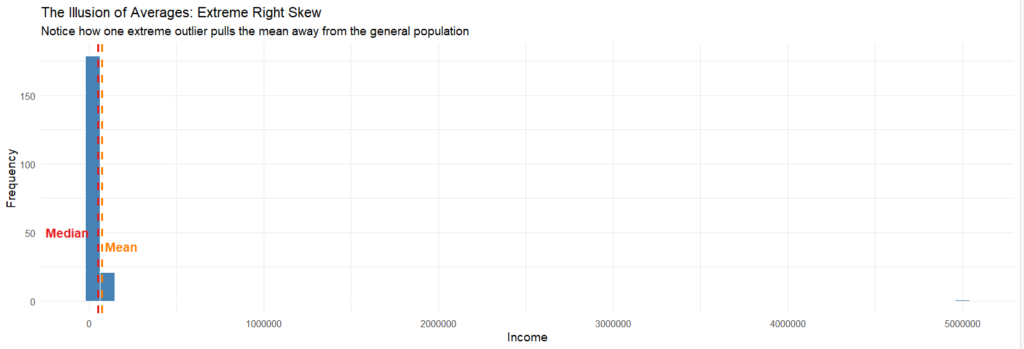
Using R, we generated a histogram showing a severely right-skewed income distribution after adding a single billionaire to a typical neighborhood. Presenting this stark visual, we ask learners a core question: “Why does the ‘average salary’ of this dataset feel like a lie?” This design prompts them to actively investigate the impact of outliers. This perfectly aligns with the knowledge construction view of multimedia learning: “…the learner is an active sense maker who experiences a multimedia presentation and tries to integrate the presented material into a coherent mental representation” (Mayer, 2014, p. 35).
Cognitive Processing and Tool Selection In building the technological environment, the minimalist static R chart eliminates extraneous interactive distractions. The core theoretical basis behind this design is: “The third assumption is that humans actively engage in cognitive processing in order to construct a coherent mental representation of their experiences” (Mayer, 2014, p. 60). By combining inquiry-based design with minimalist visuals, we ensure that students’ energy is entirely focused on the statistical logic of the data, allowing them to truly construct data literacy through inquiry.
References
Mayer, R. E. (2014). Introduction to multimedia learning. In R. E. Mayer (Ed.), The Cambridge handbook of multimedia learning (2nd ed., pp. 22-40). Cambridge University Press.
Mayer, R. E. (2014). Cognitive theory of multimedia learning. In R. E. Mayer (Ed.), The Cambridge handbook of multimedia learning (2nd ed., pp. 55-76). Cambridge University Press.